> For the complete documentation index, see [llms.txt](https://docs.itsaffinity.com/llms.txt). Markdown versions of documentation pages are available by appending `.md` to page URLs; this page is available as [Markdown](https://docs.itsaffinity.com/product-guides/external-organizations/training-management/assigning-training.md).
# Assigning Training
For any training in your catalogue, you can assign to organizations that are part of your portfolio.
## Assignment Details
Each training assignment, will specify:
* Portfolio Companies
* Due Date
* Required learners
* Required vs Optional
* Notes to the admins
## Assigning
There are a few ways to assign trainings to your portfolio organizations:
* Via the Training Detail page
* Via the Company Detail page
### Training Detail Page Assignment
To start assigning to members of your portfolio, click the "Assign Companies" button to start the interactive experience.
### Company Detail Page Assignment
On the company detail page, you can click the "Assign Trainings" button to begin a process of assigning one or more trainings to this particular company. If you are assigning more than one training to a particular company, then all trainings will have the same required information that you set up. Example being that the due date for all might be March 31st, 2024.
## Assigning Process
Let's walk through the process for creating these assignments, regardless of which entry into the flow you chose to take.
### 1. Select the portfolio companies to assign a specific training to:
### 2. Filter targeted learners of these companies:
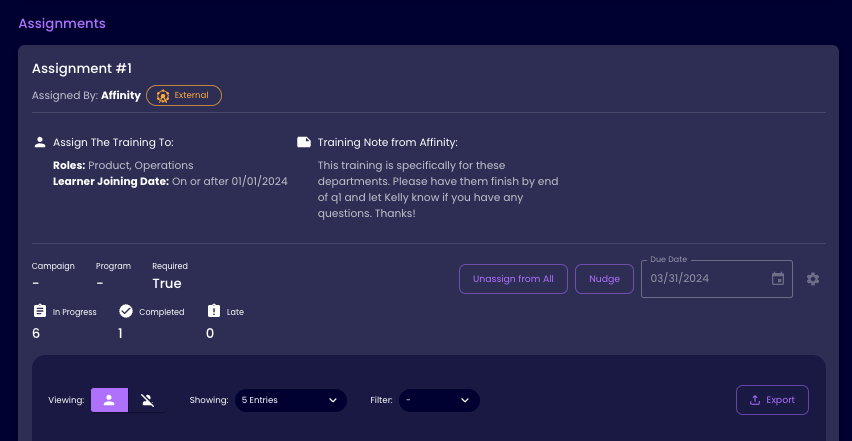
You can indicate to the companies which learners they should assign to this training. The available filters are:
* All learners: all learners they have enrolled on their platform
* Filter by department: select one or more departments that are required
* Filter by Joining Date: select a join date that anyone who has joined the organization after would mark them as eligible
You can combine the department and join date filters together. This might be applicable if you want a training assignment to target something like "All Operations employees employed after Jan 1, 2024" as part of a training program for 2024 new operations learners.
### 3. Set the Due Date:
The training should have a due date assigned.
### 4. Set any optional notes
You can add optional notes to the admin of the portfolio company. These notes will be private between your admins and the clients admins. They will show up on their training instance panel to help inform them of how to set up the trainings.
### 5. Review and Create
Finally, review your decisions and create and assign the training when ready. This will be immediately rolled out to the targeted client organizations in your portfolio.
## Client View
Your client will see all of this information in their admin panel for a particular training instance. An example of this is: